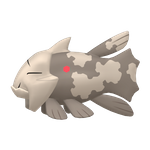
Relicanth ジーランス
Eau
Roche
3e Génération
Pokémon Longévité
Taille 1.0m Poids 23.4kg
Glissade
Tête de Roc
Fermeté (Talent caché)
Profil du Pokémon
RELICANTH is a Pokémon species that existed for a hundred million years without ever changing its form. This ancient Pokémon feeds on microscopic organisms with its toothless mouth.
Statistiques de base
Stats de base de la forme:Relicanth · Total 485
PV
100
Attaque
90
Défense
130
Atq. Spé.
45
Déf. Spé.
65
Vitesse
55
Informations de base
- Ratio de genre
- ♂ 87.5% / ♀ 12.5%
- Taux de capture
- 25(3.3%)
- Groupes d'œuf
- Eau 1 / Eau 2
- Cycles d'éclosion
- 40
- Bonheur de base
- 50
- EV rapportés
- PV+1、Défense+1
- Expérience de base
- 170
- Forme du corps
- Pisciforme
- Couleur
- Gris
- Expérience
- 1,250,000(Lent)
Affinités de types Voir le tableau complet des types →
Défensif (quand on est attaqué)
Faiblesse ×4
Plante ×4
Faiblesse ×2
Électrik ×2
Combat ×2
Sol ×2
Résistance 1/4
Feu ×0.25
Résistance 1/2
Normal ×0.5
Glace ×0.5
Poison ×0.5
Vol ×0.5
Chaîne d'évolution
 Relicanth
Apprentissage
| Niveau | Capacités | Type | Catégorie | Puissance | Précision | PP |
|---|---|---|---|---|---|---|
| — | Charge | Normal | Physique | 40 | 100 | 35 |
| — | Armure | Normal | Statut | — | — | 30 |
| 5 | Pistolet à O | Eau | Spécial | 40 | 100 | 25 |
| 10 | Pouvoir Antique | Roche | Spécial | 60 | 100 | 5 |
| 15 | Bâillement | Normal | Statut | — | — | 10 |
| 20 | Plongée | Eau | Physique | 80 | 100 | 10 |
| 25 | Bélier | Normal | Physique | 90 | 85 | 20 |
| 30 | Hydro-Queue | Eau | Physique | 90 | 90 | 10 |
| 35 | Repos | Psy | Statut | — | — | 10 |
| 40 | Gigotage | Normal | Physique | — | 100 | 15 |
| 45 | Hydrocanon | Eau | Spécial | 110 | 80 | 5 |
| 50 | Damoclès | Normal | Physique | 120 | 100 | 15 |
| 55 | Fracass’Tête | Roche | Physique | 150 | 80 | 5 |
| CT | Capacités | Type | Catégorie | Puissance | Précision | PP |
|---|---|---|---|---|---|---|
| 招式学习器08 | Ultralaser | Normal | Spécial | 150 | 90 | 5 |
| 招式学习器09 | Giga Impact | Normal | Physique | 150 | 90 | 5 |
| 招式学习器19 | Rune Protect | Normal | Statut | — | — | 25 |
| 招式学习器21 | Repos | Psy | Statut | — | — | 10 |
| 招式学习器22 | Éboulement | Roche | Physique | 75 | 90 | 10 |
| 招式学习器24 | Ronflement | Normal | Spécial | 50 | 100 | 15 |
| 招式学习器25 | Abri | Normal | Statut | — | — | 10 |
| 招式学习器27 | Vent Glace | Glace | Spécial | 55 | 95 | 15 |
| 招式学习器31 | Attraction | Normal | Statut | — | 100 | 15 |
| 招式学习器32 | Tempête de Sable | Roche | Statut | — | — | 10 |
| 招式学习器33 | Danse Pluie | Eau | Statut | — | — | 5 |
| 招式学习器35 | Grêle | Glace | Statut | — | — | 10 |
| 招式学习器36 | Siphon | Eau | Spécial | 35 | 85 | 15 |
| 招式学习器39 | Façade | Normal | Physique | 70 | 100 | 20 |
| 招式学习器45 | Plongée | Eau | Physique | 80 | 100 | 10 |
| 招式学习器48 | Tomberoche | Roche | Physique | 60 | 95 | 15 |
| 招式学习器52 | Rebond | Vol | Physique | 85 | 85 | 5 |
| 招式学习器53 | Tir de Boue | Sol | Spécial | 55 | 95 | 15 |
| 招式学习器54 | Boule Roc | Roche | Physique | 25 | 90 | 10 |
| 招式学习器55 | Saumure | Eau | Spécial | 65 | 100 | 10 |
| 招式学习器76 | Chant Canon | Normal | Spécial | 60 | 100 | 15 |
| 招式学习器81 | Piétisol | Sol | Physique | 60 | 100 | 20 |
| 招式学习器98 | Trépignement | Sol | Physique | 75 | 100 | 10 |
| 招式记录01 | Plaquage | Normal | Physique | 85 | 100 | 15 |
| 招式记录03 | Hydrocanon | Eau | Spécial | 110 | 80 | 5 |
| 招式记录04 | Surf | Eau | Spécial | 90 | 100 | 15 |
| 招式记录05 | Laser Glace | Glace | Spécial | 90 | 100 | 10 |
| 招式记录06 | Blizzard | Glace | Spécial | 110 | 70 | 5 |
| 招式记录10 | Séisme | Sol | Physique | 100 | 100 | 10 |
| 招式记录16 | Cascade | Eau | Physique | 80 | 100 | 15 |
| 招式记录17 | Amnésie | Psy | Statut | — | — | 20 |
| 招式记录20 | Clonage | Normal | Statut | — | — | 10 |
| 招式记录26 | Ténacité | Normal | Statut | — | — | 10 |
| 招式记录27 | Blabla Dodo | Normal | Statut | — | — | 10 |
| 招式记录45 | Ocroupi | Eau | Spécial | 90 | 85 | 10 |
| 招式记录46 | Mur de Fer | Acier | Statut | — | — | 15 |
| 招式记录49 | Plénitude | Psy | Statut | — | — | 20 |
| 招式记录67 | Telluriforce | Sol | Spécial | 90 | 100 | 10 |
| 招式记录69 | Psykoud’Boul | Psy | Physique | 80 | 90 | 15 |
| 招式记录75 | Lame de Roc | Roche | Physique | 100 | 80 | 5 |
| 招式记录76 | Piège de Roc | Roche | Statut | — | — | 20 |
| 招式记录84 | Ébullition | Eau | Spécial | 80 | 100 | 15 |
| 招式记录98 | Aqua-Brèche | Eau | Physique | 85 | 100 | 10 |
| 招式记录99 | Big Splash | Combat | Physique | 80 | 100 | 10 |
Movesets compétitifs et sets de Relicanth
Les movesets de Relicanth couvrent 6 générations et 13 formats avec 24 sets au total, incluant capacités, talents, objets, natures, EVs et types Téracristal avec analyse.
6 Génération
13 Format
24 set
Voir tous les movesets
Entrées du Pokédex
Generation III
- Ruby:
- RELICANTH is a Pokémon species that existed for a hundred million years without ever changing its form. This ancient Pokémon feeds on microscopic organisms with its toothless mouth.
- Sapphire:
- RELICANTH is a rare species that was discovered in deep-sea explorations. This Pokémon’s body withstands the enormous water pressure of the ocean depths. Its body is covered in tough scales that are like craggy rocks.
- Emerald:
- A Pokémon that was once believed to have been extinct. The species has not changed its form for 100 million years. It walks on the seafloor using its pectoral fins.
- FireRed:
- It has remained unchanged for 100 million years. It was discovered during a deep-sea exploration.
Generation IV
- Diamond:
- A rare Pokémon discovered during a deep-sea exploration. It has not changed in over 100 million years.
- HeartGold:
- Discovered by chance during deep-sea explorations, it has not changed since ancient times.
Generation V
- Black:
- A rare Pokémon discovered during a deep-sea exploration. It has not changed in over 100 million years.
Generation VI
- X:
- It has remained unchanged for 100 million years. It was discovered during a deep-sea exploration.
- Y:
- A rare Pokémon discovered during a deep-sea exploration. It has not changed in over 100 million years.
- Omega Ruby:
- Relicanth is a Pokémon species that existed for a hundred million years without ever changing its form. This ancient Pokémon feeds on microscopic organisms with its toothless mouth.
- Alpha Sapphire:
- Relicanth is a rare species that was discovered in deep-sea explorations. This Pokémon’s body withstands the enormous water pressure of the ocean depths. Its body is covered in tough scales that are like craggy rocks.
Generation VII
- Sun:
- Its form has remained the same for one hundred million years. Its body is filled with fat, so it can withstand the water pressure of the deep sea.
- Moon:
- It was fortuitously discovered during a deep sea expedition. Its teeth have atrophied, so it now survives on microscopic organisms it sucks up.
- Ultra Sun:
- Thought to have gone extinct, Relicanth was given a name that is a variation of the name of the person who discovered it.
- Ultra Moon:
- The reason it hasn’t changed at all in a hundred million years is that it’s apparently already a perfect life-form.
Generation VIII
- Sword:
- Rock-hard scales and oil-filled swim bladders allow this Pokémon to survive the intense water pressure of the deep sea.
- Shield:
- This Pokémon was discovered during deep-sea exploration. Its appearance hasn’t changed in 100,000,000 years, so it’s called a living fossil.